RL access nodes
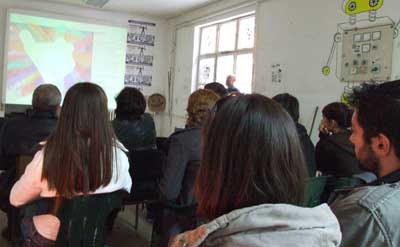
RL (real life) access nodes are held in conjunction with the UpStage festival to provide venues for proximal audiences in some locations. RL access nodes are physical venues that host screenings of sections of the festival. In the past these venues have included galleries, museums, theatres, university lecture rooms and public libraries, located all over the world (usually it’s a space that’s open to the public). If you’d like to find out more about what’s involved in hosting a node, click here.
Here are the 101010 nodes confirmed so far, and there is information about hosting a node here, if you are interested in doing that.
View 101010 RL access nodes in a larger map
101010 Nodes confirmed so far (times shown are local times):
- Tempo Festival – Auckland, New Zealand: 8pm – 10pm Sunday 10 October
- New Zealand Film Archive – Wellington, New Zealand: 10am-5pm Monday 11 October
- Le Petit Versaille, New York: 3pm – 11pm Sunday 10 October
- Norsk Telemuseum – Oslo, Norway: 11am-6pm Sunday 10 October
- AP033 – Nantes, France: 9am-6pm Sunday 10 October
- Temporary Art Centre – Eindhoven, Netherlands: 2pm-5pm Sunday 10 October
- Galerija Elektrika – Pancevo, Serbia: times TBC
- Syneme, Calgary, Canada: times TBC
- Ljudmila Laboratory, Ljubljana, Slovenia
- The Starving Artist Collective, Keene, New Hampshire, USA
- Vietnam – location TBC: from 7pm Sunday 10 October

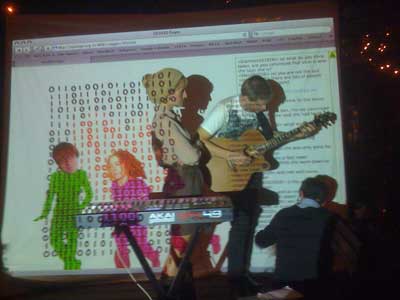
Munich node, photo: © 2008 by um
Hosting a RL access node
Hosting a RL access node for the 101010 UpStage Festival is not difficult, and it can be an innovative addition to an organisation’s existing programme or be a great one-off event. Here’s what you need:
- a stable broadband internet connection: it doesn’t need to be super-fast, a standard broadband connection is fine. You will need to check the network in case additional ports in the firewall need to be opened – this takes only a few minutes and we can help you to do it
- data projector, screen or projection surface, and speakers or sound system
- computer for projector: a standard computer with a standard browser and the Flash player plug-in installed. This computer needs to be accessed by someone who can navigate from one stage to the next (this just requires clicking on a link)
- 2-3 audience computers, or the ability for audience to be online with their own laptops: if you can’t provide this it’s not the end of the world, but it greatly enhances the experience for the audience if they can also see how it is for the online audience, and interact with them
- someone who can act as the “host” – to say a few words about UpStage at the festival at the beginning and invite the audience to use the audience computers if you have them. If your node is in a gallery or museum situation this person may be someone who works there who can provide information and assistance to visitors about UpStage and the festival.
Additionally, nodes usually promote the event through their own channels, such as their organisation’s web site and mailing list, and perhaps print material as well. We can provide logo, images and text copy if you need it. We are also interested in any ideas you may have for integrating UpStage into existing programmes.
Nodes choose what times they will operate; some galleries and museums have operated their node for their opening hours on the day of the festival while other nodes have selected a specific couple of hours that will be the best time for them to get an audience. We take the nodes’ operating hours into consideration as we schedule the performances, but we also have to take into account the many time zones of the performers, so it’s a tricky business!
If you have any other questions about being a node, or would like to offer to host one, please email info@upstage.org.nz

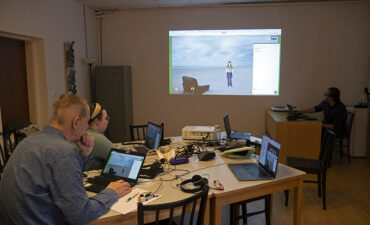
Node at the Norsk Telemuseum, Oslo, 2008. Photographer Cato Normann